
How Does a Ribbon Blender Work? | Ribbon Mixer Guide

In adhesives, sealants, and fine-chemical plants, the horizontal ribbon blender remains the workhorse for blending powders, pastes, and high-viscosity formulations. Yet many buyers evaluate it only by drum volume. Understanding the working principle explains why one blender reaches a CV of 3% in ten minutes while another runs thirty minutes without uniformity — a difference worth reading before you invest.
The Working Principle: Counter-Current Ribbon Flow
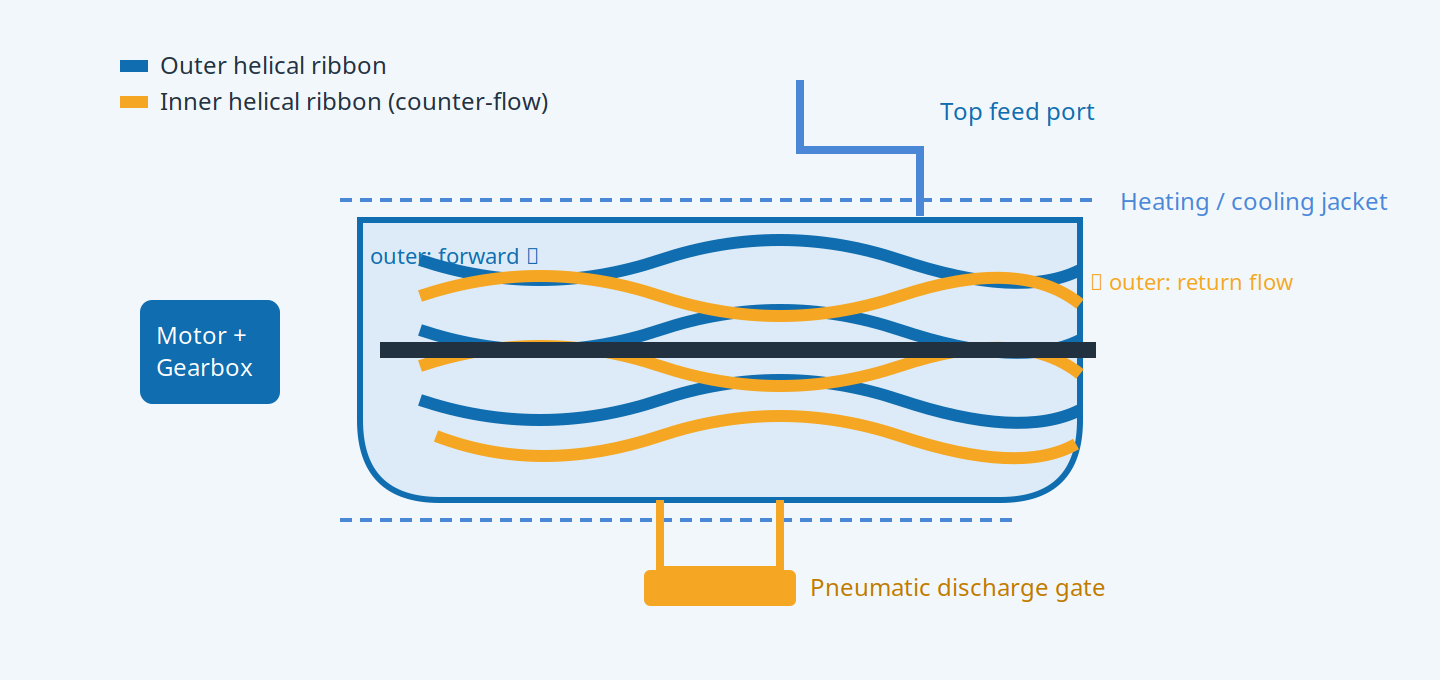
A ribbon blender works on the ribbon blender working principle of counter-current material circulation. Inside a U-shaped trough, a central shaft carries two helical ribbons: the outer ribbon pushes material toward the discharge end, while the inner ribbon returns it in the opposite direction. This creates simultaneous axial and radial movement, so every particle crosses the mixing zone repeatedly instead of rotating as one frozen block.
1)Charging — powders, fillers, and additives are loaded to 40–70% of trough volume. Overloading is the most common cause of poor uniformity.
2)Circulation — ribbons shear, fold, and convey the bed; agglomerates break down as material crosses the shaft repeatedly.
3)Temperature conditioning — a jacketed trough holds viscosity stable during resin or heat-sensitive blending.
4)Discharge — a full-length gate (pneumatic or manual) empties the trough in 2–5 minutes with minimal residue.
Key Specification Ranges (Chemical Grade)
|
Parameter |
Typical range |
Why it matters |
|
Working volume |
100 – 20,000 L |
Match batch size to downstream filling capacity |
|
Mixing time |
5 – 15 min |
Longer cycles indicate wrong ribbon clearance, not "more mixing" |
|
Shaft speed |
20 – 60 rpm |
Low speed protects fragile granules |
|
Uniformity (CV) |
≤ 3–5% |
Core acceptance standard for industrial powder mixing equipment |
|
Contact material |
SUS304 / SUS316L |
316L required for corrosive chemical formulations |
Buying Mistakes to Avoid
- Sizing by total volume, not working volume. Real capacity is 40–70% of trough volume.
- Ignoring ribbon-to-wall clearance. A 5–10 mm clearance is critical for complete discharge of sticky pastes.
- Omitting the jacket. Viscosity drift during blending directly degrades adhesive consistency.
- Underestimating motor power for high filler loads. Torque demand rises sharply above 60% solid content.
Advantages vs. Limitations
Advantages
- High throughput per floor area
- Handles powders, pastes, and slurries in one machine
- Full-open discharge, easy CIP cleaning
- Proven, low maintenance cost
Limitations
- Not ideal for very high speeds or fluidized blending
- Shaft seals need checking on abrasive fillers
- Batch process — no true continuous feed
Typical Applications
For industrial powder mixing equipment buyers, ribbon blenders serve epoxy filler compounds, silicone sealant bases, construction dry-mix adhesives, pigment masterbatches, and fertilizer granule coating — anywhere repeatable, gentle, high-volume blending defines product quality.
FAQ
| Q1: Can a ribbon blender handle wet, sticky adhesive pastes? |
Yes, up to high-viscosity paste ranges, provided the trough is jacketed and paddle-type ribbon profiles are specified. Above paste-grade viscosity, MIC recommends our horizontal particle-design mixer or sigma blade units.
| Q2: What information do you need for a quotation? |
Material characteristics (viscosity, solid content, abrasiveness), batch weight, discharge height, and site power supply. We return a configured proposal within 48 hours.
| Q3: How is the machine installed and commissioned on site? |
Units ship skid-mounted or with anchor templates. Installation takes 1–2 days; our engineers then run a water-trial and your actual formulation trial to verify CV uniformity before sign-off.
| Q4: What does the warranty cover? |
12 months on the drive system and structural components, with lifetime spare-part supply and remote video support. On-site service is available for production-line projects.
| Q5: The blender leaks at the shaft seal — what should I check? |
First inspect seal packing wear and air-purge pressure (if fitted). Persistent leakage usually means seal faces are scored by abrasive fillers; replacement cartridge seals solve it without removing the shaft.
| Q6: How do I choose between ribbon, paddle, and plough configurations? |
Ribbon suits free-flowing powders and general blending; paddles suit fragile granules; plough shares handle dense, cohesive pastes. Send us your formulation and we will run a bench feasibility test.
Conclusion
A ribbon blender mixes through counter-current helical circulation: outer ribbons convey forward, inner ribbons return, and repeated crossing of the shaft delivers uniformity of ≤3–5% CV. Working volume, ribbon clearance, jacket design, and motor torque — not drum size — determine real performance. For chemical and adhesive producers, matching these four parameters to your formulation is what turns a blender from a purchase into a process guarantee.
