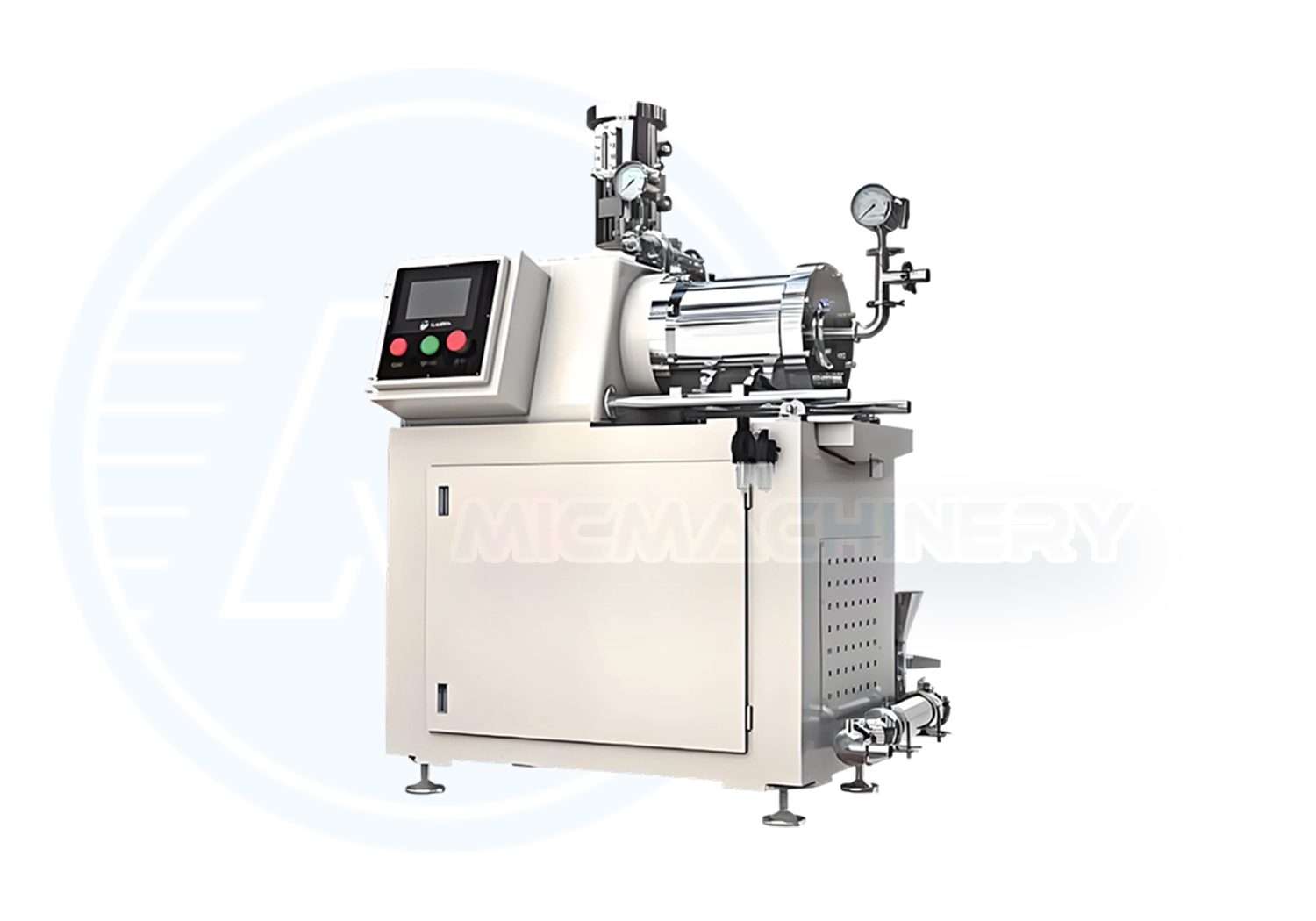
Lab Sand Mill for Adhesive Production and Material Research
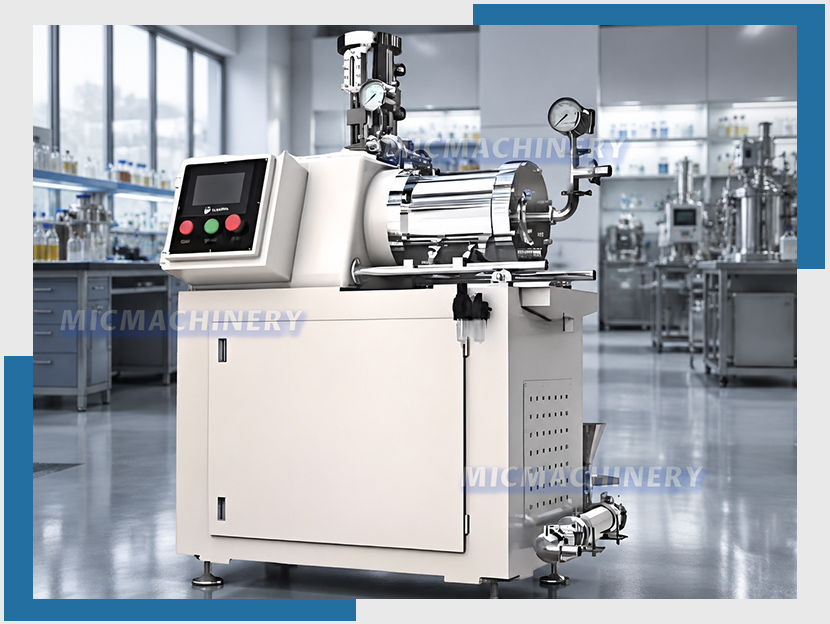
A Lab Sand Mill is designed for laboratory-scale grinding, dispersion, and formulation testing of adhesives, coatings, inks, and specialty chemicals. It helps optimize particle size, improve dispersion quality, and provide reliable data for production scale-up.
Manufacturing Process of Lab Sand Mill
The working principle of a laboratory sand mill is based on high-energy wet grinding and dispersion.The typical manufacturing process of a Lab Sand Mill includes several key stages:
|
|
|
|
|
|
1)Material Preparation and Feeding
Raw materials are pre-mixed according to the formulation and transferred into the grinding chamber. Feed rate and material viscosity affect grinding efficiency and particle size.
-----
2)High-Energy Grinding and Dispersion
The rotor drives grinding media to create impact and shear forces, breaking down particles and improving dispersion, especially for adhesives with fillers and additives.
-----
3)Temperature Control
A cooling jacket or temperature control system maintains stable processing conditions and prevents heat-related material degradation.
-----
4)Separation and Collection
The separation system allows the finished material to exit while retaining grinding media. Samples can then be tested for particle size, stability, and performance.
|
|
|
|
|
|
Technical Advantages and Product Features
MIC Machinery’s laboratory grinding equipment is developed for precise material testing and formulation development. The main features include:
➢ Compact Design for Laboratory Operation
The machine occupies limited space while providing industrial-level grinding performance. Its compact structure makes it suitable for laboratories, pilot plants, and research facilities.
➢ High-Efficiency Dispersion Performance
The optimized grinding chamber design improves the contact efficiency between grinding media and materials. This helps achieve uniform particle size distribution and stable dispersion results.
➢ Adjustable Grinding Parameters
Operators can adjust key process parameters, including rotor speed, feeding rate, grinding time, and temperature control conditions. These adjustments allow engineers to study different formulations and processing methods.
➢ Suitable for Various Viscosity Materials
Depending on configuration, the equipment can process low to high viscosity materials used in adhesives, sealants, coatings, and chemical products.
➢ Easy Cleaning and Maintenance
The grinding chamber and material-contact components are designed for convenient cleaning and maintenance. This is important for laboratories that frequently switch between different formulations.
➢ Reliable Scale-Up Reference
Laboratory testing provides valuable process data for industrial production. Parameters obtained from a Lab Sand Mill can help engineers select suitable production equipment and optimize manufacturing processes.
Customization Options
Different adhesive formulations have different requirements regarding viscosity, particle size, temperature sensitivity, and production objectives. MIC Machinery provides customized solutions based on customer testing needs.
Customization options may include:
· Grinding chamber capacity according to batch size requirements
· Different material-contact components for chemical compatibility
· Cooling systems for temperature-sensitive products
· Special grinding media selection
· Variable speed control systems
· Customized electrical configurations for different countries and factory standards
FAQ
| What materials can be processed by a Lab Sand Mill? |
|
A laboratory sand mill can process many types of wet materials, including adhesives, sealants, coatings, inks, pigments, and specialty chemical formulations. The suitable configuration depends on material viscosity and composition.
|
| |
| What is the difference between a laboratory sand mill and a production sand mill? |
| The main difference is processing capacity. A laboratory sand mill is designed for small batches, formulation development, and testing, while production sand mills are built for continuous large-scale manufacturing. However, both use similar grinding principles. |
| |
| How does a sand mill improve adhesive quality? |
|
A sand mill improves adhesive quality by reducing particle size, breaking agglomerates, and creating more uniform dispersion. Better dispersion can improve product stability, appearance, and application performance.
|
| |
| How should grinding media be selected? |
| Grinding media selection depends on the material characteristics and desired particle size. Factors such as bead size, density, hardness, and chemical compatibility should be considered during equipment selection. |
| |
| Can the laboratory results be used for production scale-up? |
| Yes. Laboratory testing helps manufacturers understand grinding behavior and optimize formulations before investing in larger production equipment. Engineers can use test data to design a suitable industrial process. |