
How Does Air Entrapment Affect Wet Milling Efficiency?
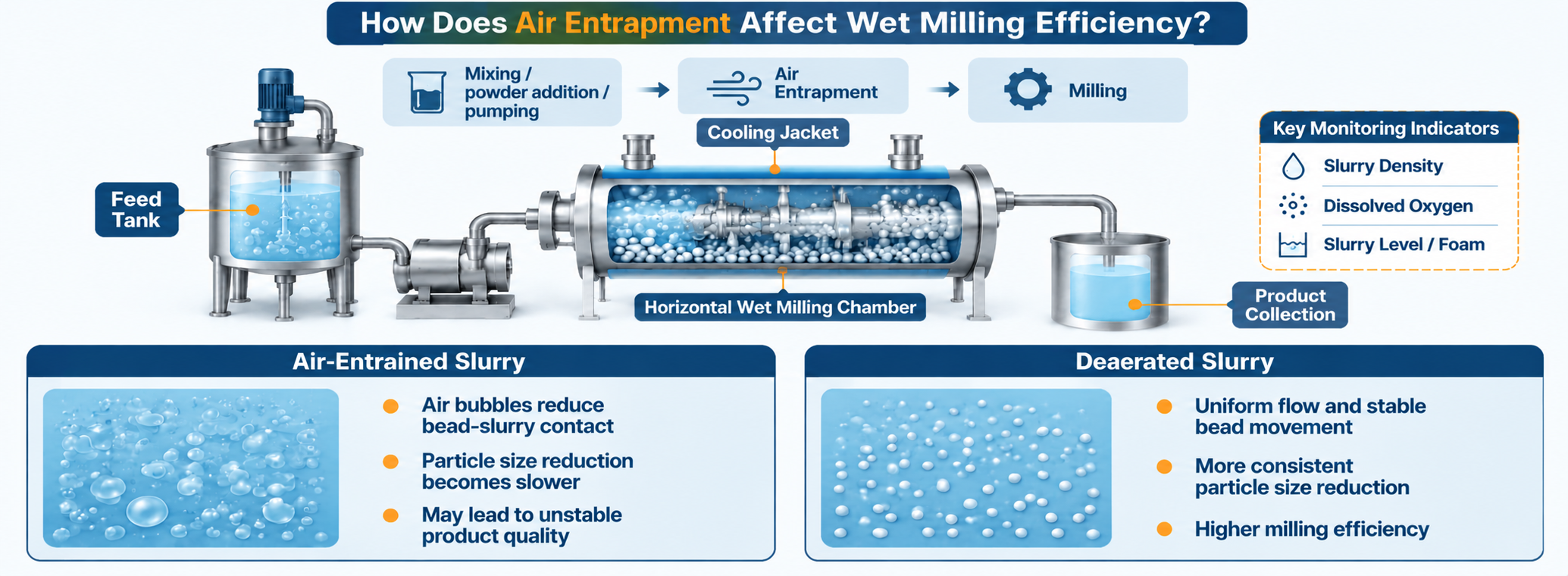
Air entrapment is an often-overlooked factor that can reduce grinding efficiency and affect product consistency in industrial wet milling. During mixing, powder feeding, pumping, or material transfer, air can enter the slurry and form dispersed bubbles or surface foam. These bubbles may interfere with slurry flow, grinding media movement, and particle size reduction.
For manufacturers processing adhesives, sealants, coatings, and chemical dispersions, controlling air incorporation is important for maintaining stable production. Understanding air entrainment in wet milling helps operators identify process losses before they develop into quality or productivity problems.
How Does Air Enter a Wet Milling System?
|
Air can enter the milling process at several stages before the slurry reaches the grinding chamber. ----- Common sources include: - High-speed mixing: Excessive agitation creates surface vortices that draw air into the liquid. - Powder addition: Rapidly adding dry fillers or pigments can introduce air into the slurry. - Pump suction: Loose connections, inadequate liquid levels, or suction-side leaks may introduce bubbles. - Material transfer: Splashing and turbulent pouring increase air incorporation. ----- In adhesive production, high-viscosity materials can retain entrained bubbles for longer periods, making them difficult to remove during normal processing. |
 |
How Does Entrained Air Reduce Wet Milling Efficiency?
In a bead mill, grinding media transfer mechanical energy to particles through impact and shear. Entrained gas can disturb this process in several ways.
- Reduced effective grinding contact: Gas pockets occupy part of the slurry volume and can interfere with local bead-slurry interactions, reducing effective energy transfer to solid particles.
- Unstable material circulation: Excessive bubbles and foam can affect slurry distribution and flow through the grinding chamber, resulting in less consistent processing conditions.
- Delayed particle size reduction: When effective grinding conditions deteriorate, particles may require additional circulation passes or longer processing time to reach the target fineness.
- Inconsistent batch results: Uneven air distribution can produce variations in slurry density and milling performance between batches.
A 2025 study published in the Journal of Pharmaceutical Sciences found that aeration impeded particle attrition during wet bead milling. The effect became more significant as the batch-to-chamber volume ratio increased. Pre-milling deaeration improved milling efficiency and reduced cycle time in the studied formulations.
How Can Manufacturers Detect Air Entrapment?
Operators should monitor several process indicators instead of relying on visible foam alone.
- Monitoring indicator Possible warning sign
- Slurry density Lower or inconsistent density
- Dissolved oxygen Changes in dissolved gas level
- Slurry height Unexpected volume expansion
- Surface condition Persistent foam or bubbles
- Particle size Slower reduction or inconsistent D90
Important: Dissolved oxygen is an indirect process indicator, not a direct measurement of total entrained gas. Density measurements and slurry observations should be evaluated together.
How Can You Reduce Air Entrapment Before Milling?
The following measures can help improve slurry deaeration and stabilize material feeding.
1)Optimize pre-mixing speed: Avoid excessive agitation and deep surface vortices.
2)Control powder addition: Add powders gradually to reduce air incorporation and improve wetting.
3)Inspect the transfer system: Check pump suction lines, seals, joints, and liquid levels for air leakage.
4)Allow sufficient deaeration time: Use a suitable holding or vacuum deaeration process when compatible with the formulation.
5)Maintain stable feeding: Avoid unnecessary flow fluctuations and air pockets entering the milling chamber.
Vacuum deaeration should be validated against formulation volatility, foaming tendency, and material stability before production.
How Does Wet Milling Equipment Design Help?
A properly configured Wet Milling Machine supports stable material circulation, controlled grinding conditions, and efficient heat removal.
MIC Machinery provides wet milling solutions for epoxy adhesives, polyurethane systems, silicone sealants, coatings, and other industrial formulations.
 |
Relevant equipment configuration options include: ---- - Milling chamber volume: Matched to production capacity and processing requirements. - Grinding media configuration: Selected according to target particle size and material properties. - Cooling jacket: Supports temperature control during continuous grinding. - Feeding system: Configured according to slurry viscosity and solid content. - Contact material: Selected according to chemical compatibility and contamination requirements ----- The equipment can also be integrated with mixing vessels, vacuum mixing systems, storage tanks, transfer pumps, and filling machines. |
Practical Recommendations for Stable Production
Before starting a production batch, operators should establish baseline measurements for slurry density, viscosity, temperature, and particle size.
A practical control checklist includes:
- Process stage Recommended action
- Pre-mixing Prevent excessive air incorporation
- Powder feeding Maintain gradual, controlled addition
- Deaeration Verify bubble removal where required
- Milling Monitor feed stability and temperature
- Quality inspection Check particle size distribution and density
The key principle is to control air before it enters the grinding chamber rather than relying on the milling process to remove it.
FAQ
| Q1. Can vacuum deaeration damage adhesive formulations? |
Yes, under unsuitable conditions. Excessive vacuum may cause volatile components to evaporate or increase foaming. Vacuum level and treatment time should be validated for each formulation.
| Q2. Should deaeration equipment be installed before or after a wet milling machine? |
Pre-milling deaeration is generally preferable when air incorporation affects grinding performance. The specific installation position depends on the mixing and transfer process.
| Q3. What should be checked during wet milling machine commissioning? |
Check motor rotation, cooling water circulation, pump operation, mechanical seals, pipeline connections, and feeding stability before introducing production material.
| Q4. How often should the grinding chamber be inspected? |
Inspection frequency depends on operating hours, material abrasiveness, and production conditions. Regularly check grinding media wear, separation components, seals, and chamber surfaces.
| Q5. Can MIC Machinery customize wet milling equipment for high-viscosity adhesives? |
Yes. MIC Machinery can customize chamber volume, grinding media configuration, motor power, feeding arrangements, and cooling systems according to adhesive viscosity, solid content, and production requirements.
| Q6. What causes unstable slurry flow during continuous milling? |
Common causes include inconsistent feeding, excessive viscosity, pump suction problems, blocked pipelines, and air accumulation. Check these conditions before changing the grinding speed.
Conclusion
Air entrapment can reduce wet milling efficiency by disrupting slurry circulation and effective grinding conditions. Powder addition, excessive mixing, and pump suction problems are common sources of unwanted air. Monitoring slurry density, dissolved oxygen, and material volume helps identify aeration problems. Proper deaeration and stable feeding improve process consistency. MIC Machinery can configure wet milling equipment according to material viscosity, production capacity, and particle size requirements.
