
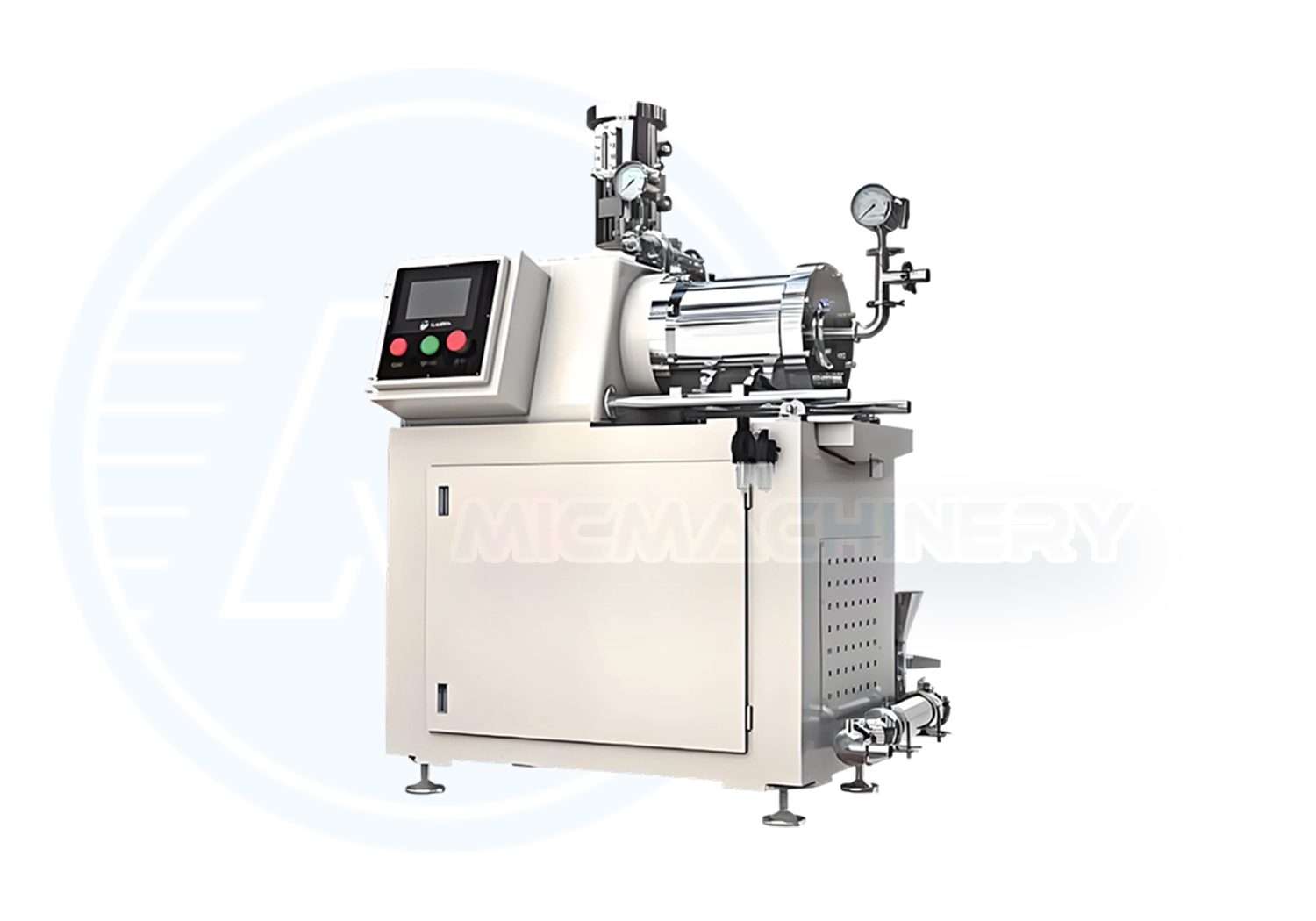

MIC Lab Sand Mill Supplier
MIC Lab Sand Mill Supplier
Mic Machinery provides advanced laboratory-level dispersion and grinding solutions through the MIC Lab Sand Mill Supplier system, designed for research institutions, material developers, and pilot production facilities. This equipment is engineered to simulate industrial-scale wet grinding behavior in a compact structure, allowing users to accurately test formulation performance, particle size reduction, and dispersion stability before full-scale production.
As a reliable lab sand mill supplier, Mic Machinery focuses on delivering consistent, repeatable, and controllable grinding performance. The system is widely used in silicone materials, coatings, inks, pigments, and chemical slurry development, where precise control over particle distribution is essential for product quality validation.
High-Efficiency Grinding Structure and Working Principle
The MIC laboratory sand mill operates using a high-speed rotating grinding chamber filled with grinding media such as zirconia beads. When the material enters the chamber, strong shear force, impact energy, and friction are generated, breaking down particles into fine and uniform sizes. This process ensures efficient dispersion even for high-viscosity or complex formulations.
As a compact lab sand mill, the system is designed to replicate industrial wet grinding conditions while maintaining laboratory-level precision. Operators can adjust key parameters such as rotor speed, feed rate, and grinding time to achieve different fineness levels. This flexibility makes it an essential tool for formulation optimization and product development.
To ensure stable and reliable operation, the system adopts a high-precision double mechanical seal design, which significantly improves sealing durability and long-term stability. The grinding chamber is fully enclosed, preventing material contamination and minimizing exposure to air. This closed design also helps reduce bubble formation during processing and effectively limits solvent evaporation, ensuring a cleaner and more controlled grinding environment.
Key Features of Laboratory Grinding System
The MIC Lab Sand Mill Supplier solution is engineered with advanced design principles to ensure reliable performance in research and testing environments. Its main features include:
· Compact structure designed for laboratory and pilot-scale applications
· High-energy grinding chamber for efficient particle size reduction
· Adjustable operating parameters for precise process control
· Compatible with a wide range of grinding media sizes
· Stable dispersion performance for high-viscosity and multi-phase materials
· Easy cleaning and quick material changeover for multi-formulation testing
These advantages make it a highly efficient lab grinding sand mill for researchers who need accurate and repeatable results in material development processes.
Applications in Silicone, Coating, and Chemical Research
The MIC Lab Sand Mill Supplier system is widely used in silicone compound development, coating formulation testing, ink dispersion research, and pigment refinement studies. In silicone applications, it ensures uniform dispersion of fillers and additives, improving elasticity, mechanical strength, and long-term stability of the final material.
During operation, the material continuously circulates through the grinding zone, where repeated collisions between beads and particles reduce agglomeration and refine particle size distribution. This process helps researchers evaluate product performance under controlled conditions, ensuring smooth transition from laboratory testing to industrial production.
The system functions effectively as a lab sand mill for both experimental research and pre-production validation, providing critical data for scale-up processes.
Efficiency, Control, and Reliable Laboratory Performance
The MIC Lab Sand Mill Supplier equipment is designed with user-friendly operation and precise control systems. A digital interface allows researchers to monitor and adjust operating parameters in real time, ensuring accurate experimental conditions. The compact structure saves laboratory space while maintaining high grinding efficiency comparable to industrial systems.
Energy-efficient motor design and optimized internal flow dynamics reduce power consumption while maintaining stable grinding performance. The machine is also built with corrosion-resistant and wear-resistant materials, ensuring long-term durability even under frequent experimental use.
As a result, the system provides not only reliable laboratory performance but also a dependable lab grinding sand mill platform for advanced material development and formulation optimization.
Conclusion
The MIC Lab Sand Mill Supplier solution from Mic Machinery represents a professional approach to laboratory-scale wet grinding technology. By combining precision engineering, flexible control, and stable dispersion performance, it supports a wide range of research and development needs. Whether used for silicone materials, coatings, or chemical formulations, this system ensures accurate particle refinement and consistent testing results, making it an essential tool for modern material innovation.
|
Model |
Effective Volume(L) |
Motor Power(kW) |
Batch Capacity(L) |
Flow Rate(kg/h) |
Dimension(mm) |
Weight(kg) |
|
WSM-1 |
1 |
4 |
3-30 |
20-60 |
950*650*800 |
150 |
|
WSM-5 |
5 |
5.5 |
20-100 |
20-200 |
1100*800*1500 |
400 |
|
WSM-10 |
10 |
11 |
50-260 |
60-800 |
1250*900*1600 |
750 |
|
BSM-0.5 |
0.5 |
4 |
2-20 |
15-100 |
900*700*1000 |
160 |
|
BSM-1 |
1 |
4 |
2-30 |
15-100 |
900*700*1000 |
165 |
|
BSM-2 |
2 |
7.5 |
10-100 |
200-500 |
1150*1110*1250 |
350 |
|
BSM-10 |
10 |
18.5-22 |
20-150 |
200-800 |
1200*1100*1600 |
960 |
* BSM refers to a pin-type structure, while WSM refers to a disc-type structure.
* The selection depends on factors such as material viscosity, grinding conditions, and the pump conveying method.
Please feel free to let us know if you need any help, we will provide a professional guidance for you! Contact Us