
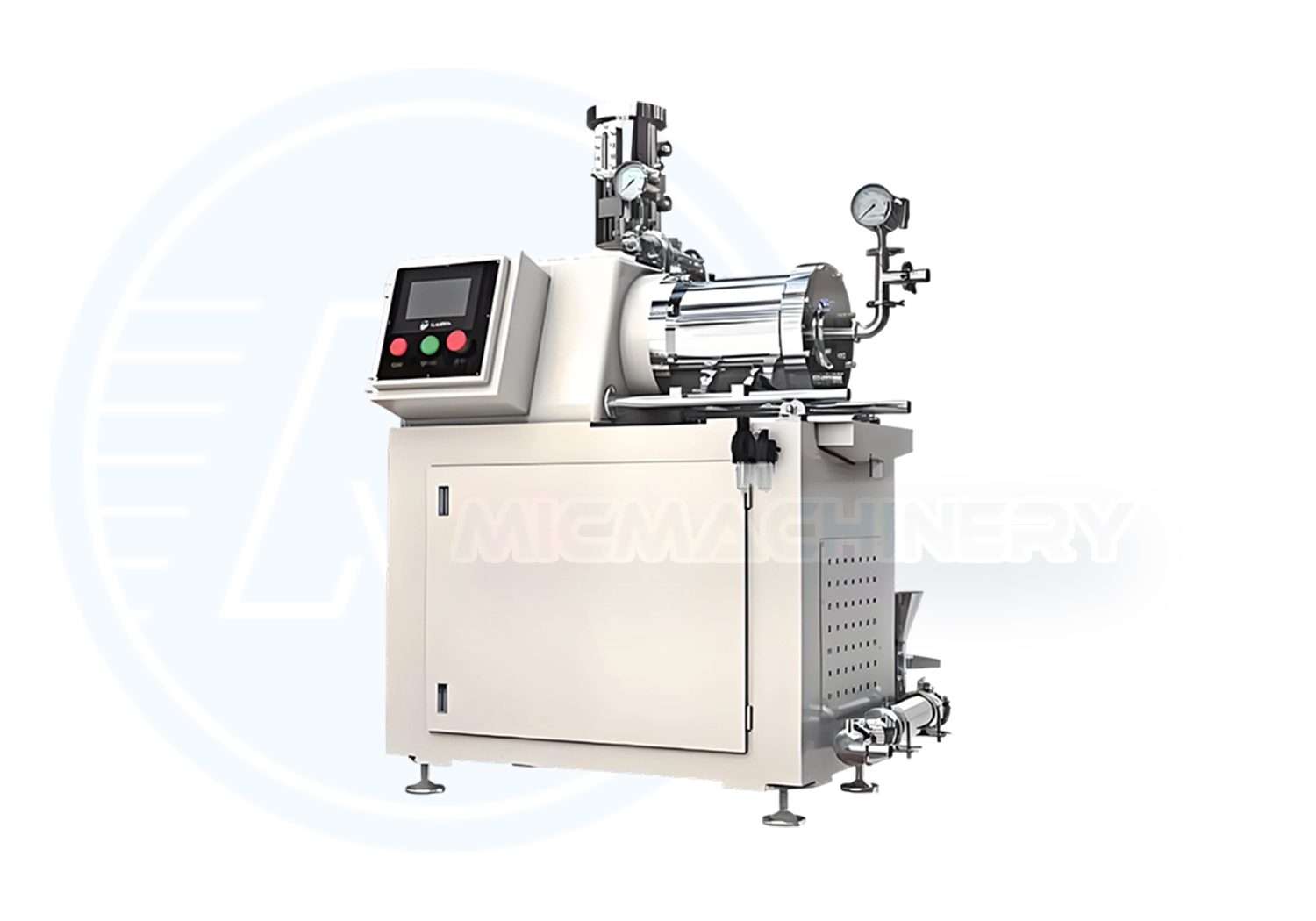

MIC Laboratory Horizontal Sand Mill
MIC Laboratory Horizontal Sand Mill Introduction
MIC Machinery designs the MIC Laboratory Horizontal Sand Mill for precision wet grinding and material development in modern chemical and silicone-related industries. It is engineered to simulate industrial-scale dispersion while maintaining the flexibility required for laboratory testing and small-batch production. This machine is widely used for evaluating formulation stability, particle size reduction, and process optimization before mass production.
Precise Grinding for Laboratory Applications
The laboratory sand mill is built with a compact structure but retains full industrial grinding principles. It uses a high-speed rotating grinding rotor combined with selected grinding media to achieve strong shear and impact forces. As a result, materials can be processed into ultra-fine particles with narrow size distribution.
In R&D environments, engineers often rely on a horizontal sand mill machine to test different formulations. Compared with traditional mixers, it provides higher energy transfer efficiency and more stable grinding results. The controlled operation helps researchers better understand viscosity changes, dispersion behavior, and final product performance.
Stable Performance and Flexible Operation
One of the key advantages of this equipment is its stable and controllable grinding process. The cooling system effectively manages temperature rise during continuous operation, ensuring consistent product quality. The chamber is designed for easy disassembly, allowing quick cleaning and color change, which is essential for laboratory use.
The horizontal sand mill structure also ensures uniform material flow, reducing dead zones and improving grinding consistency. Operators can adjust speed, feed rate, and residence time according to different material requirements. This flexibility makes it suitable for coatings, inks, dyes, pigments, and silicone-based materials.
To ensure safe and stable operation, the mill adopts a precision double-end mechanical seal design, which enhances durability and reliability during long-term use. The fully enclosed grinding chamber effectively prevents material leakage and contamination, while also minimizing air contact during processing. This helps reduce bubble formation and limits solvent evaporation, supporting cleaner and more stable grinding conditions.
Key advantages include:
· Precise temperature control system for stable grinding conditions
· Easy-to-clean grinding chamber for fast material changeover
· Adjustable operating parameters for different formulation tests
· High-efficiency dispersion for nano and micro-scale grinding results
Efficient Design for R&D and Small Batch Production
MIC Machinery focuses on both performance and usability. The Laboratory Horizontal Sand Mill is equipped with wear-resistant components, ensuring long service life even under frequent testing conditions. Its energy-efficient design reduces operational cost while maintaining high grinding efficiency.
For customers seeking reliable equipment supply, MIC Machinery also supports horizontal sand mill wholesale solutions for distributors, laboratories, and production facilities. This allows bulk procurement with consistent quality standards and technical support. Whether used for formulation research or pilot production, the machine ensures repeatable and scalable results.
Wide Industrial Applications and Technical Value
This laboratory mill is widely applied in industries requiring fine dispersion, such as coatings, printing inks, chemical pigments, and silicone materials. It helps engineers shorten development cycles by providing accurate testing data before full-scale manufacturing.
With strong adaptability and precise control, the MIC Laboratory Horizontal Sand Mill has become an essential tool for modern material innovation. It bridges the gap between laboratory research and industrial production, ensuring smoother process transition and higher product reliability in large-scale applications.
|
Model |
Effective Volume(L) |
Motor Power(kW) |
Batch Capacity(L) |
Flow Rate(kg/h) |
Dimension(mm) |
Weight(kg) |
|
WSM-1 |
1 |
4 |
3-30 |
20-60 |
950*650*800 |
150 |
|
WSM-5 |
5 |
5.5 |
20-100 |
20-200 |
1100*800*1500 |
400 |
|
WSM-10 |
10 |
11 |
50-260 |
60-800 |
1250*900*1600 |
750 |
|
BSM-0.5 |
0.5 |
4 |
2-20 |
15-100 |
900*700*1000 |
160 |
|
BSM-1 |
1 |
4 |
2-30 |
15-100 |
900*700*1000 |
165 |
|
BSM-2 |
2 |
7.5 |
10-100 |
200-500 |
1150*1110*1250 |
350 |
|
BSM-10 |
10 |
18.5-22 |
20-150 |
200-800 |
1200*1100*1600 |
960 |
* BSM refers to a pin-type structure, while WSM refers to a disc-type structure.
* The selection depends on factors such as material viscosity, grinding conditions, and the pump conveying method.
Please feel free to let us know if you need any help, we will provide a professional guidance for you! Contact Us